
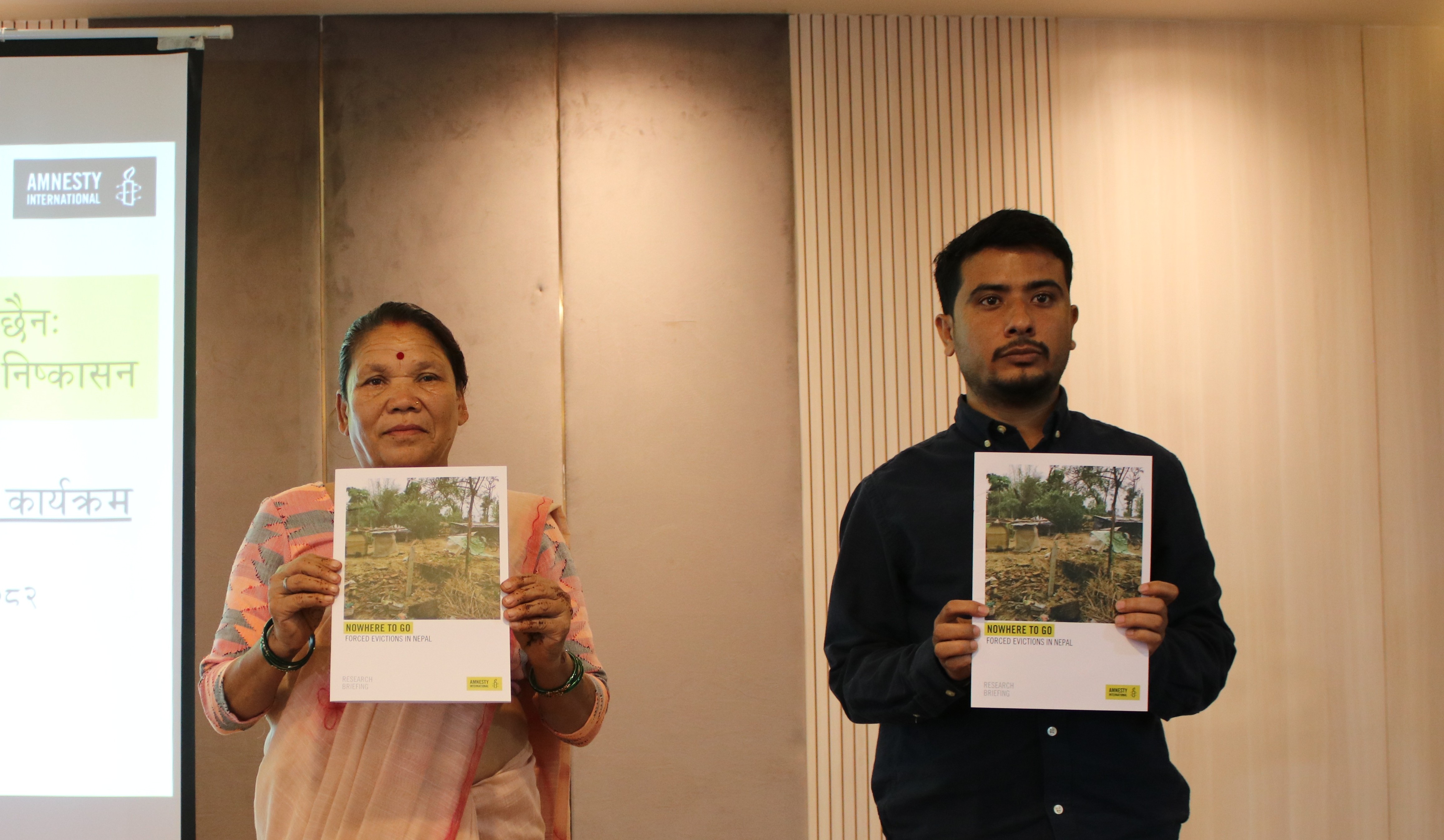
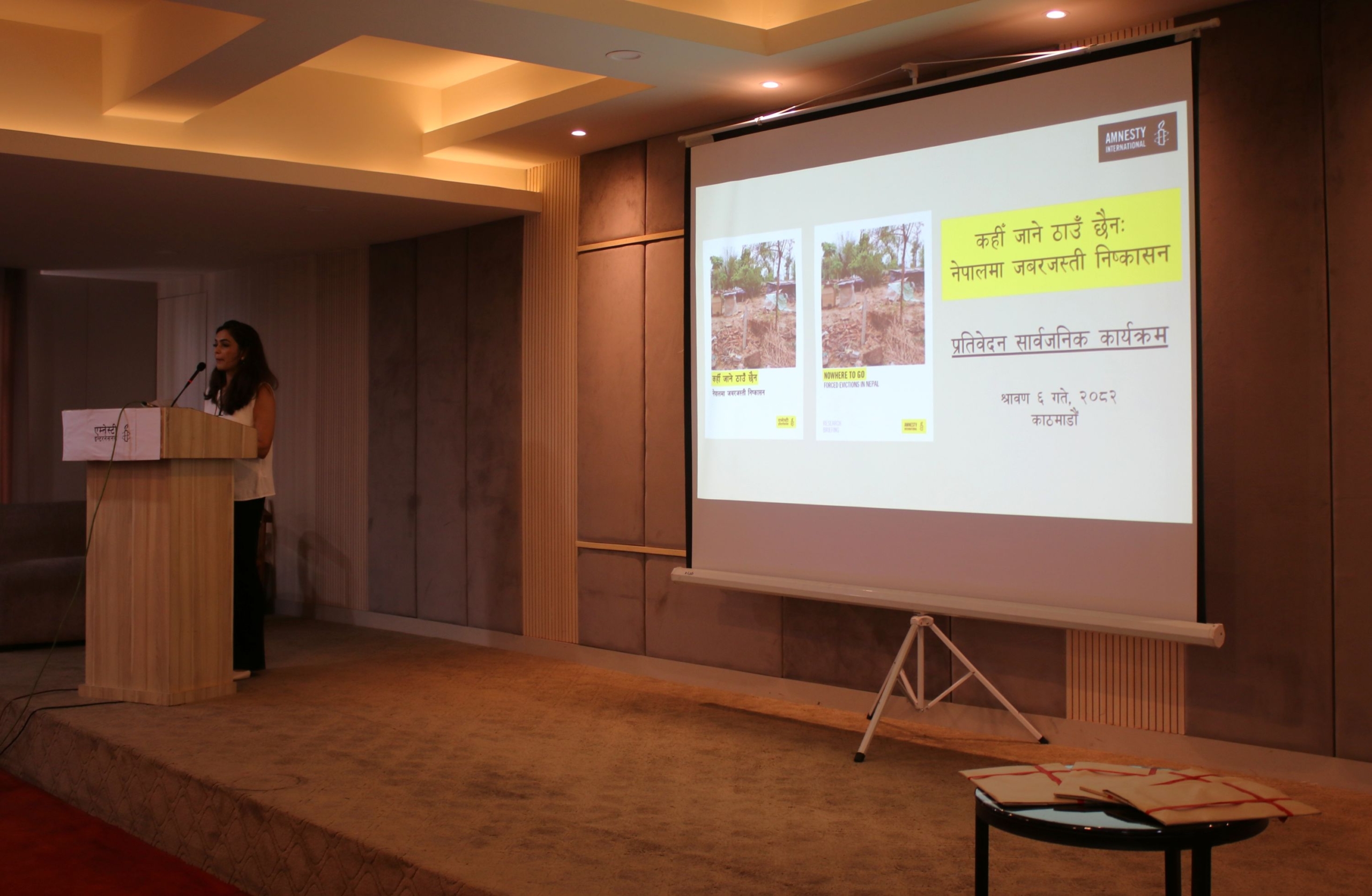
On 22 July 2025, Amnesty International launched its latest research briefing titled “‘Nowhere to Go: Forced Evictions in Nepal” at a program held in Kathmandu. The report exposes an alarming rise in forced evictions across Nepal in recent years and the State’s failure to protect people’s right to adequate housing, particularly for marginalized groups such as Dalits and Indigenous Peoples. Despite legal safeguards enshrined in the Constitution and the Right to Housing Act of 2018, the report finds that these protections have largely failed to translate into meaningful change on the ground.
The brief was launched in an event organized by Amnesty International (AI) Nepal in the presence and participation of media persons, human rights activists, government officials, and rights holders. Amnesty International Nepal’s Chairperson Bipin Budhathoki and Januka Pokherel, a resident of the Thapathali informal settlement in Kathmandu who has witnessed and been a victim of two eviction efforts in 2012 and 2022, jointly unveiled the report. Pokharel continues to live in the same location even today due to a lack of other viable options and has spent decades navigating a life marked by instability and repeated evictions.
Following the official launch, Nirajan Thapaliya, Director of Amnesty International Nepal, presented the key findings of the report, which focuses on five emblematic cases of forced evictions between 2020 and 2024. These include evictions in Kusum Khola, Chitwan (July 2020); Chaukidanda, Kailali (May 2021); Thapathali, Kathmandu (November 2022); Purano Airport Area, Dhangadhi (June 2024); and Bhajani, Kailali (June 2024). The research draws on two field investigations conducted in 2024 in Kailali, Siraha, Sunsari, and Jhapa districts, and on long-term documentation by AI Nepal and its civil society partners, including the Community Self-Reliance Centre (CSRC), Justice and Rights Institute Nepal (JuRI-Nepal), Nepal Mahila Ekata Samaj, and the Informal Sector Service Centre (INSEC).
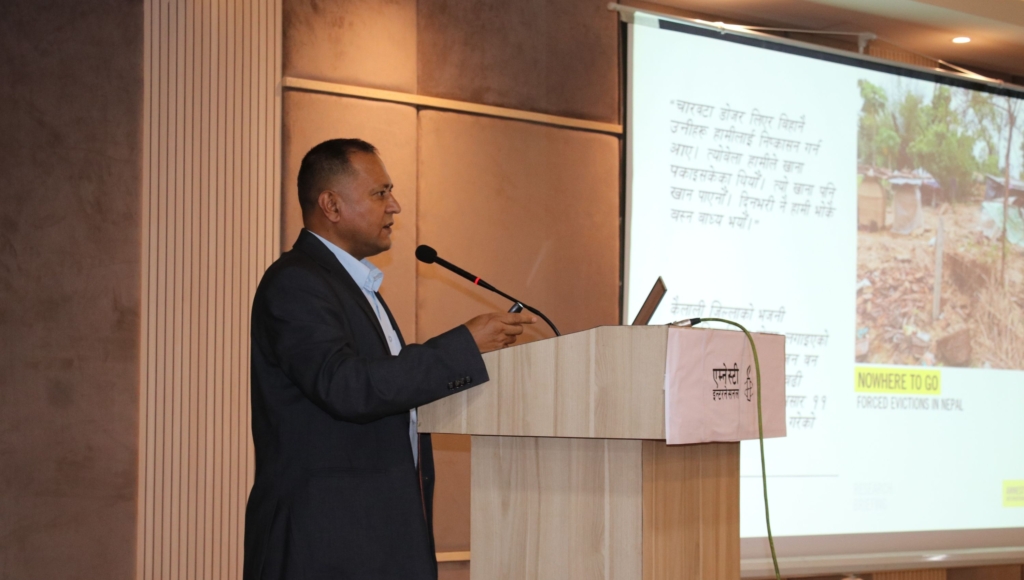
Thapaliya stressed that the recurring theme throughout the report is the Nepali State’s repeated failure to uphold procedural safeguards and protect the rights of affected communities. Despite the provisions of the Right to Housing Act of 2018 and international legal obligations, authorities frequently carried out evictions without prior consultation, adequate notice, or the provision of alternatives.
One of the key challenges identified in the report is the absence of a comprehensive regulatory framework to implement the Right to Housing Act. Additionally, older conflicting laws—such as the Lands Act of 1964 —have not been harmonized with newer human rights-based legislation, further weakening protections for informal settlers. A lack of coordination between federal, provincial, and local governments has created space for evicting authorities to bypass legal obligations and disregard agreements made with the Land Issue Resolving Commission.
Following the presentation, representatives of partner civil society organizations and government agencies shared their reflections. Dhana Shrestha, Board Secretary of Nepal Mahila Ekata Samaj, emphasized the need for equality in legal protections, sharing, “Human rights must be equal for everyone. Why are the rich and the privileged subject to different rules and the poor to different rules? The right to adequate housing is for all and should be respected and fulfilled without any discrimination. Is this country no place for the poor? Forced evictions cannot be done in the name of development without providing an acceptable alternative to the affected. They push marginalized and disadvantaged communities deeper into poverty.”
Is this country no place for the poor? Forced evictions cannot
Dhana Shrestha, Board Secretary of Nepal Mahila Ekata Samaj
be done in the name of development without providing an
acceptable alternative to the affected. They push marginalized and disadvantaged communities deeper into poverty
Bijaya Rana, Under Secretary at the Indigenous Nationalities Commission, acknowledged that the report had highlighted key issues but urged that the lens be widened. “The report rightly highlights the issue of forced evictions and its impact on landless and indigenous people. But it could go further by examining the displacement caused by large-scale development projects,” he said.
He also noted Nepal’s international commitments and emphasized a willingness to work together, “Nepal has endorsed the UN Declaration on the Rights of Indigenous Peoples (UNDRIP) that ensures the principle of free, prior, and informed consent (FPIC) in decisions affecting Indigenous communities. There’s much we can collaborate on—whether it’s lobbying for FPIC or engaging with UN mechanisms. The Commission is always open to collaboration.”
Nawaraj Sapkota, Joint Secretary at the National Human Rights Commission (NHRC), reflected on the challenges the NHRC faces in addressing this issue: “We’ve documented three to four cases of forced evictions ourselves, but the problem is widespread and growing, especially due to development projects.”
He admitted that economic, social, and cultural rights have not received the attention they deserve: “Land ownership is a major issue—not only for relocation but also for compensation. While some initial work has begun on the right to housing, it hasn’t yet been substantial. This report provides a crucial opportunity to shift that.”
Dr. Jagat Basnet, Expert Member of the Land Issue Resolving Commission, offered technical clarifications about the Commission’s mandate, saying, “Our priority is to resolve this—first by addressing the needs of Dalits, then landless individuals, followed by unmanaged settlers.”
He added that the Commission is working closely with local governments to resolve the issue by 2085 BS (2028 AD). “We’ve assigned deadlines for identification and verification of the landless and unmanaged dwellers at the local level. Our aim is to complete this by the end of the fiscal year. We’ve also issued a press release to not carry out any evictions until this process is completed,” he added.
Senior Advocate Raju Chapagai, who also largely contributed to this research, delivered a powerful critique of the State’s actions as well as inactions. “This is a complex, deeply entrenched issue. When a bulldozer destroys someone’s home, it’s not just a structure being razed—it’s the Constitution of the country itself.”
This is a complex, deeply entrenched issue. When a bulldozer
Senior Advocate Raju Chapagai
destroys someone’s home, it’s not just a structure being
razed—it’s the Constitution of the country itself
He framed the state’s actions as a fundamental contradiction: “How can a State that claims to uphold socialist values forcibly evict its most marginalized citizens? This isn’t just a human rights violation—it’s a moral failure, and in some cases, a crime that is impermissible by humanitarian law even at the worst of times such as internal or international conflict.”
Chapagain concluded his remarks by calling on State institutions to act, saying, “This report should serve as a stepping stone for institutions like the NHRC and Indigenous Nationalities Commission to investigate further and do the needful to hold authorities accountable.”
Charan Prasai, former Chair of Amnesty International Nepal, spoke about the psychological impact of State violence. “We must end the dehumanization of poor families. These are people deserving equal enjoyment of the constitutionally guaranteed rights—not obstacles. The terror of bulldozer, which is often used to an alarming degree at all local levels by the elected authorities to crush people’s fundamental rights, including the Right to Housing, in the name of development is a matter of huge concern. This is alarming. Nepal’s rights groups and constitutional agencies including the NHRC must proactively investigate these evictions and ensure that humanity is respected and the right to adequate housing is never compromised.”
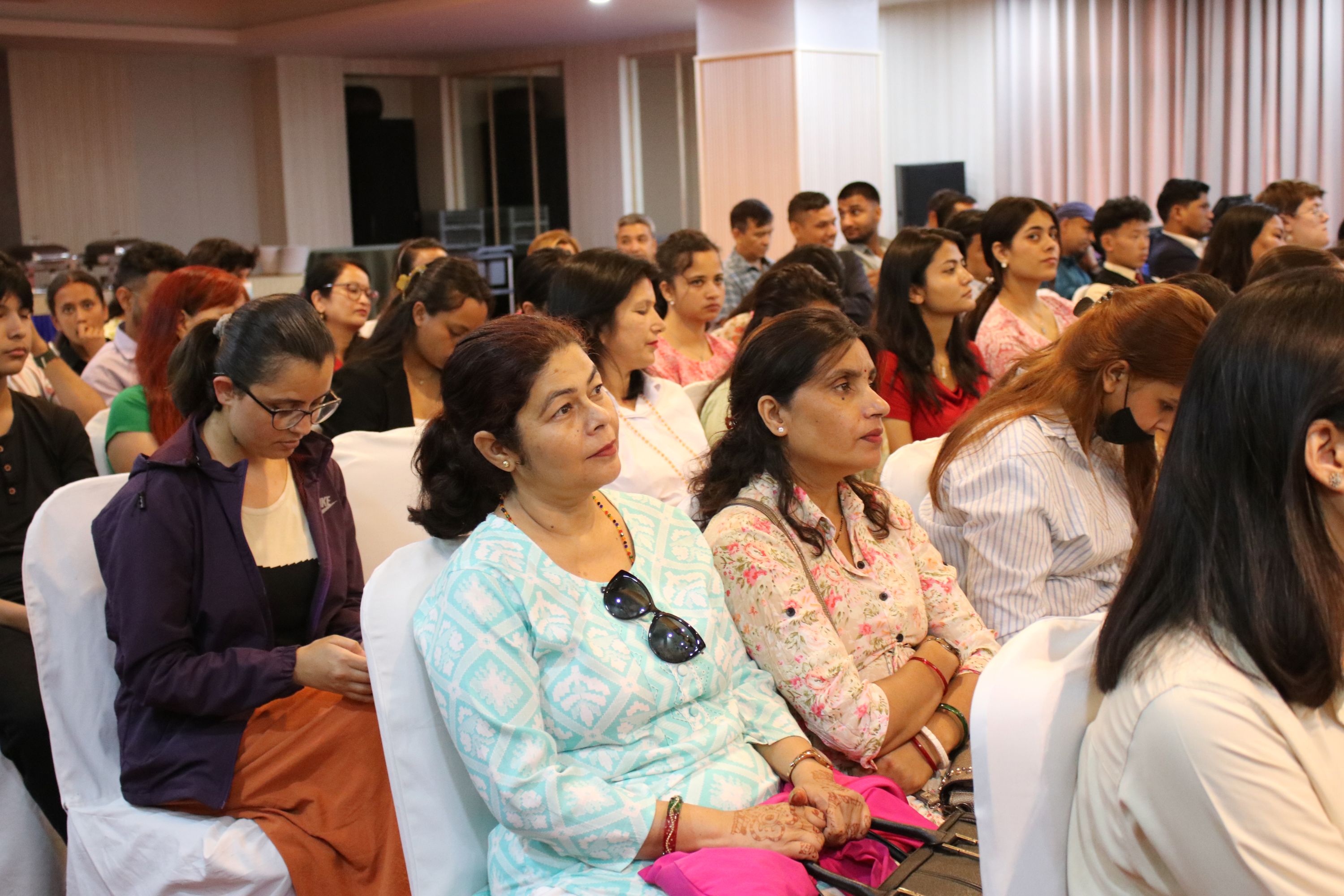
Closing the event, Amnesty International Nepal Chairperson Bipin Budhathoki reiterated the central message of the report and urged unified action. “What we’re witnessing is a growing pattern of state indifference. Development must not come at the cost of human dignity and human lives. The state has a responsibility to protect—not punish—its people.”
The report, “Nowhere to Go: Forced Evictions in Nepal”, offers a stark reminder that for many in Nepal, the right to housing remains a promise unfulfilled. Amnesty International Nepal and its partners call on authorities at all levels to end this cycle of injustice, ensure justice for affected communities, and uphold the fundamental human right to adequate housing.