
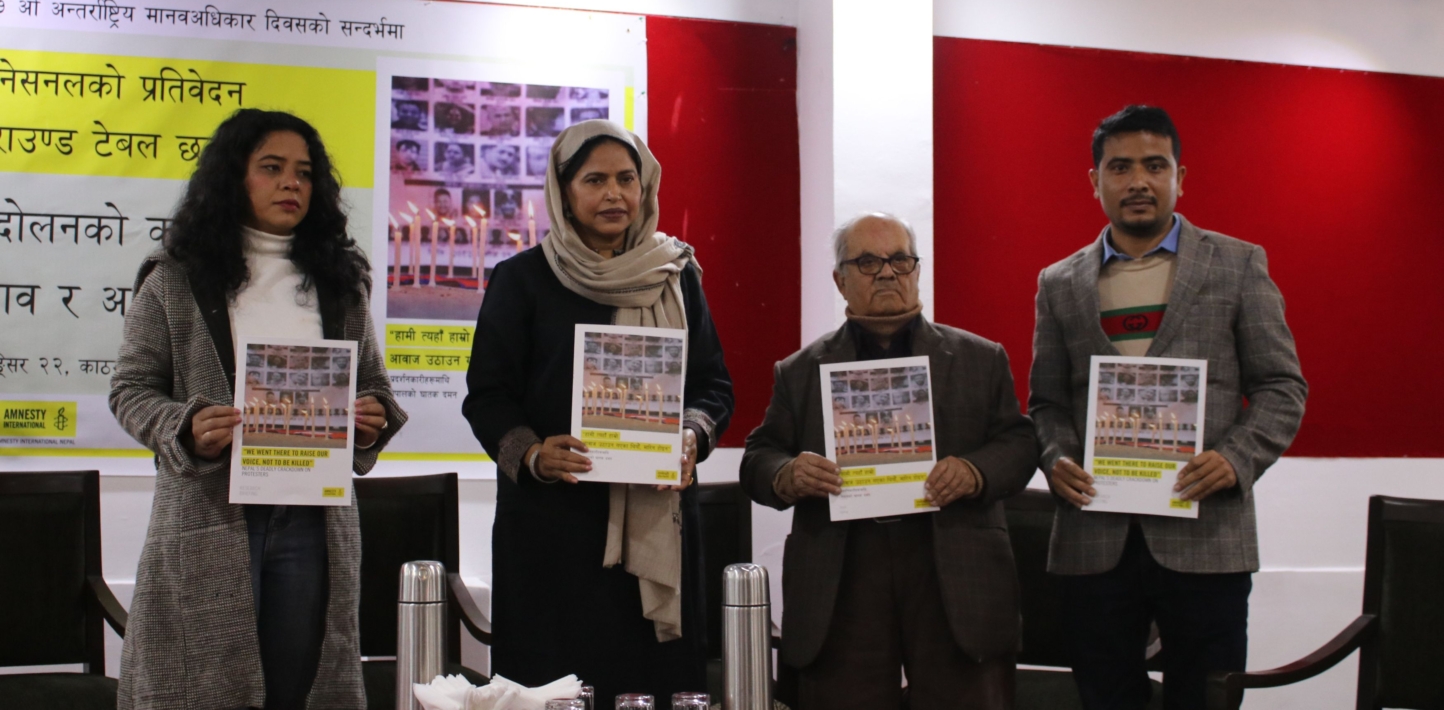
On 8 December, Amnesty International released a research briefing titled “We went there to raise our voice, not to be killed”: Nepal’s Deadly Crackdown on Protesters, shedding light on Nepal’s violent response to peaceful protesters in Nepal’s Gen-Z protests on 8 September. The briefing documents how security forces used mounting, excessive, and ultimately lethal force—including the use of live ammunition—against the largely peaceful protesters who had gathered to raise their voice against corruption, misgovernance and to assert their right to freedom of expression and peaceful assembly.
The briefing was physically launched in Kathmandu by Amnesty International Nepal, jointly unveiled by Nutan Thapaliya, Founder of Amnesty Nepal; Bipin Budhathoki, Chairperson of Amnesty Nepal; human rights defender and former National Human Rights Commission’s (NHRC) Commissioner Mohna Ansari; and Geeta Rasaili, Chair of the Conflict Victims Women National Network (CVWN).
The 8 September protest in Kathmandu alone resulted in at least 19 deaths and more than 300 injuries in a single day, making it one of the deadliest crackdowns in Nepal during a peaceful assembly. Across Nepal, the two-day wave of protests and the six days of subsequent unrest left at least 76 individuals dead and more than 2,000 injured.
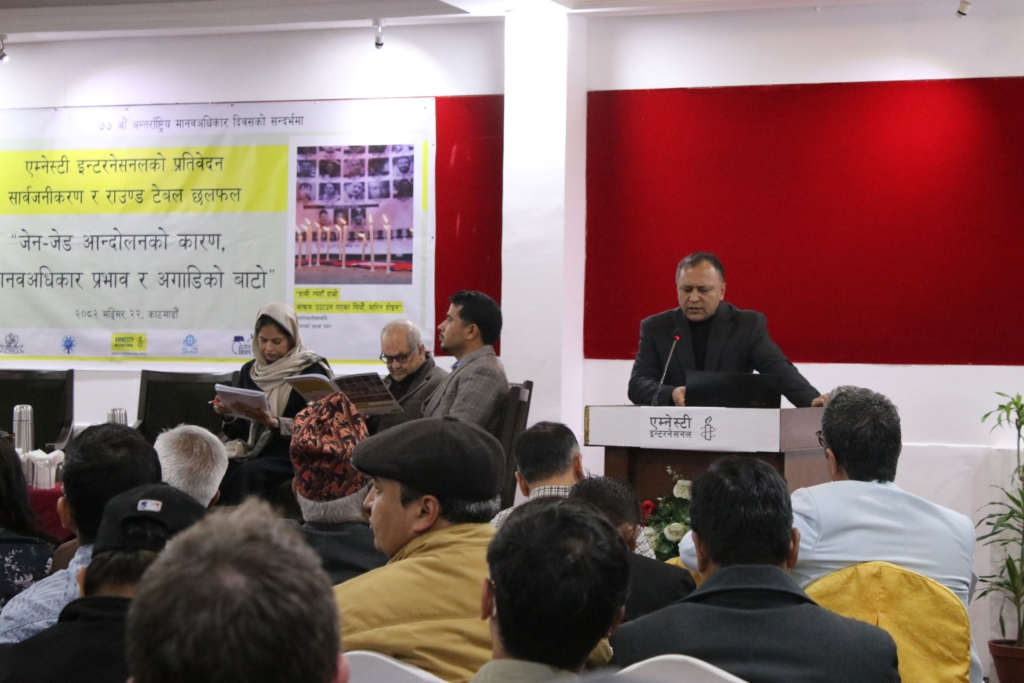
The key findings of Amnesty International’s research briefing were presented by Nirajan Thapaliya, Amnesty International Nepal’s Director, who detailed the nature of the excessive force used by security personnel and highlighted serious violations of international human rights standards. His presentation underscored not only the scale of the violence but also the urgent need for independent investigations and accountability through fair trial to prevent future abuses.
To foster a broader conversation on the Gen-Z movement, Amnesty International Nepal, together with Accountability Watch Committee, Advocacy Forum, Informal Sector service Center (INSEC), and Justice and Rights Institute Nepal (JuRI-Nepal), also organized a panel discussion titled “Gen Z Movement: Its Causes, Human Rights Consequences, and Way Forward” or “जेन-जेड आन्दोलनको कारण, मानवअधिकार प्रभाव र अगाडिको बाटो”.
The panel discussion brought together an impressive range of voices: Gen-Z activist Monisha Choudhary; human rights defender and former NHRC Commissioner Mohna Ansari; Gita Rasaili, Chair of the CVWN; senior advocate Raju Prasad Chapagai; anthropologist Dr. Suresh Dhakal; and Kumar Tamang Yatru, journalist and Coordinator at Indigenous TV. Moderated by sociologist Dipesh Ghimire, the dialogue explored the roots of the Gen-Z movement, the deep-seated frustrations that mobilized young people across the country, and the broader human rights consequences of the state’s response.
Dr. Suresh Dhakal highlighted the socio-anthropological roots of these frustrations, noting that while the protests addressed many inequalities, they primarily focused on state-created disparities and overlooked many historical injustices, such as caste-based discrimination. Meanwhile, Gita Rasaili drew parallels between the 1996-2006 conflict-related human rights violations and the Gen-Z protests, emphasizing that transitional justice should not be limited to victims of past conflicts; rather, structural reviews of institutions like the army, police, and political parties are necessary to prevent repeated mistakes. According to Rasaili, the culture of impunity—with which those responsible for atrocities during the Maoist conflict can walk free, and where violence results in no accountability—culminated in the events seen during the Gen-Z protests.
Kumar Tamang Yatru shed light on the historical injustices faced by marginalized communities, including Tharu, Tamang, and Sherpa communities. He highlighted the importance of a human rights lens for minority communities, referencing ILO Convention 169 and the UN Declaration on the Rights of Indigenous Peoples (UNDRIP), and noted that while federalism provides legal protections on paper, people’s access to land, territory, and resources still remains severely restricted and needs to be a part of discussions henceforth.
Monisha Chaudhary discussed why Gen-Z youth took to the streets, pointing not only to youth’s frustrations regarding corruption but also to entrenched social structures and repeated instances of impunity. She emphasized that rule of law has often applied to citizens but not to the state itself, and that systemic ruptures were central to the protest’s intentions.
Reflecting on the broader human rights implications, Mohna Ansari stated, “We are going through a painful situation in this country. It is sad that this is not something new—whether it was during the first People’s Movement or the Maoist conflict, the State’s response to its own citizens has been to suppress dissent. The events that unfolded on 8 September and the pervading culture of impunity are deeply concerning. Take any country—the US, UK, Italy—thousands can protest without facing gunfire there. But in Nepal, even when just a hundred people are out, security forces are armed. It is tragic that the country’s security forces protect politicians but not its ordinary citizens.”
Senior advocate Raju Prasad Chapagain reflected on the selective implementation of the Constitution, adding that the culture of impunity has persisted, with those responsible for human rights violations—ranging from gender-based violence to caste discrimination and economic disparity—rarely held accountable. Chapagai emphasized that these systemic failures contributed to the scale and intensity of the Gen-Z protests.
The panel was followed by a brief question-and-answer session, during which participants reflected on the findings and shared concerns about accountability, governance, and the protection of civic space.
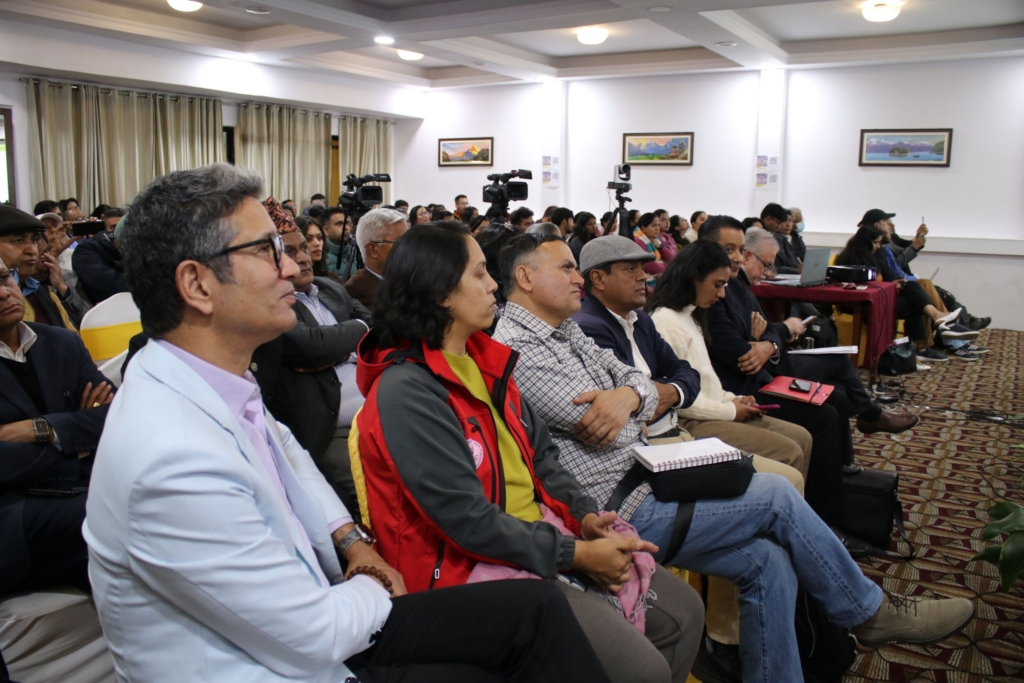
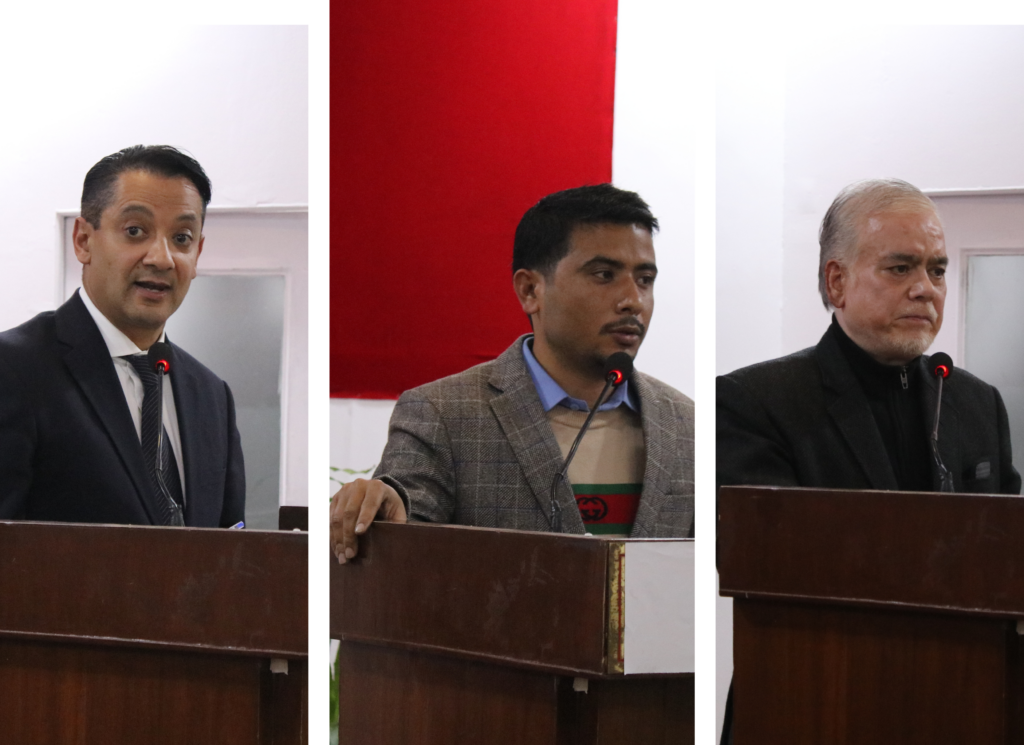
Khaled Hassine, a Human Rights Officer from Office of the United Nations High Commissioner for Human Rights (OHCHR), Geneva, then shared the United Nations’ perspective on the Gen-Z movement, emphasizing Nepal’s obligations under international human rights law and the importance of safeguarding the right to peaceful assembly. Following his remarks, former Amnesty Nepal Chairperson and human rights activist Charan Prasai noted that the events of 8 September serve as a stark reminder that the state must hear its citizens rather than attempt to silence them. He stressed that the path ahead requires transparency and a renewed commitment to delivering justice to state-sanctioned atrocities till date.
INSEC Executive Director Bijay Gautam highlighted the crucial role that documentation plays a crucial role in contributing meaningfully to the pursuit of truth, justice, and accountability. He noted that although Nepal is a signatory to numerous international human rights obligations, it has repeatedly failed to uphold them in practice, emphasizing the persistent ineffectiveness of transitional justice bodies in ensuring accountability.
Amnesty Nepal Chairperson Bipin Budhathoki delivered the closing remarks, reaffirming Amnesty Nepal’s commitment to advocating for justice and ensuring that the voices of young protesters and victims are not forgotten. He noted that the launch of Amnesty International’s briefing and the ensuing dialogue mark a pivotal moment in Nepal’s human rights landscape, adding that the Gen-Z movement, driven by the courage and determination of young Nepalis, has underscored the urgent need for accountability, institutional reform, and stronger protections for civil liberties.