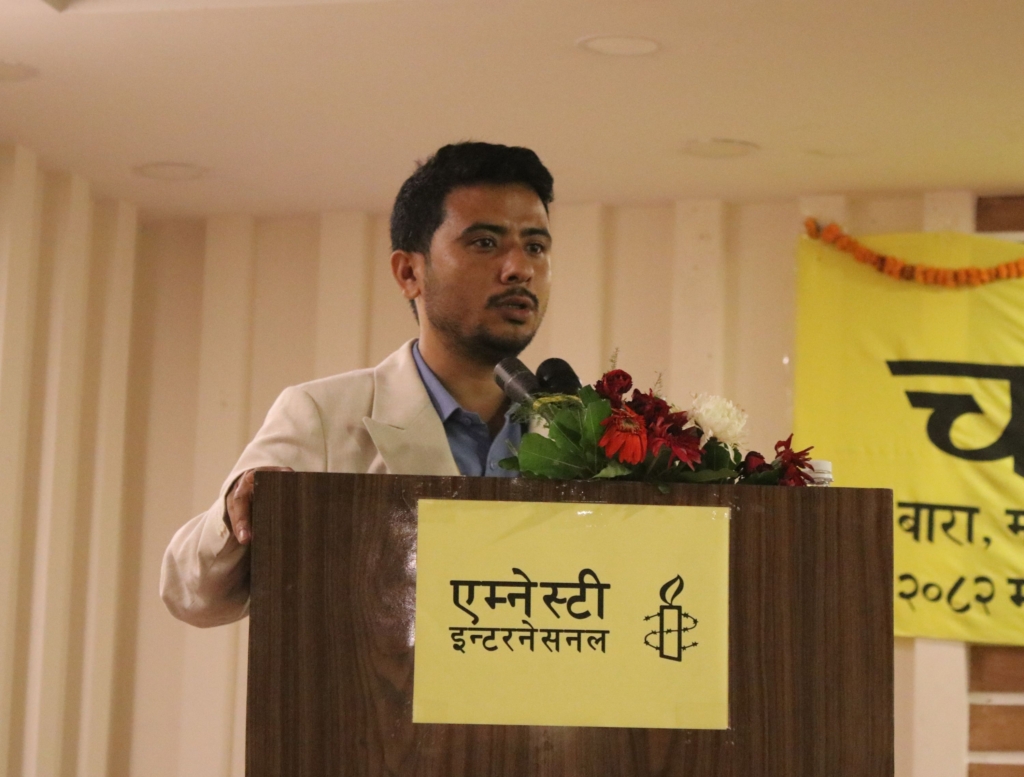

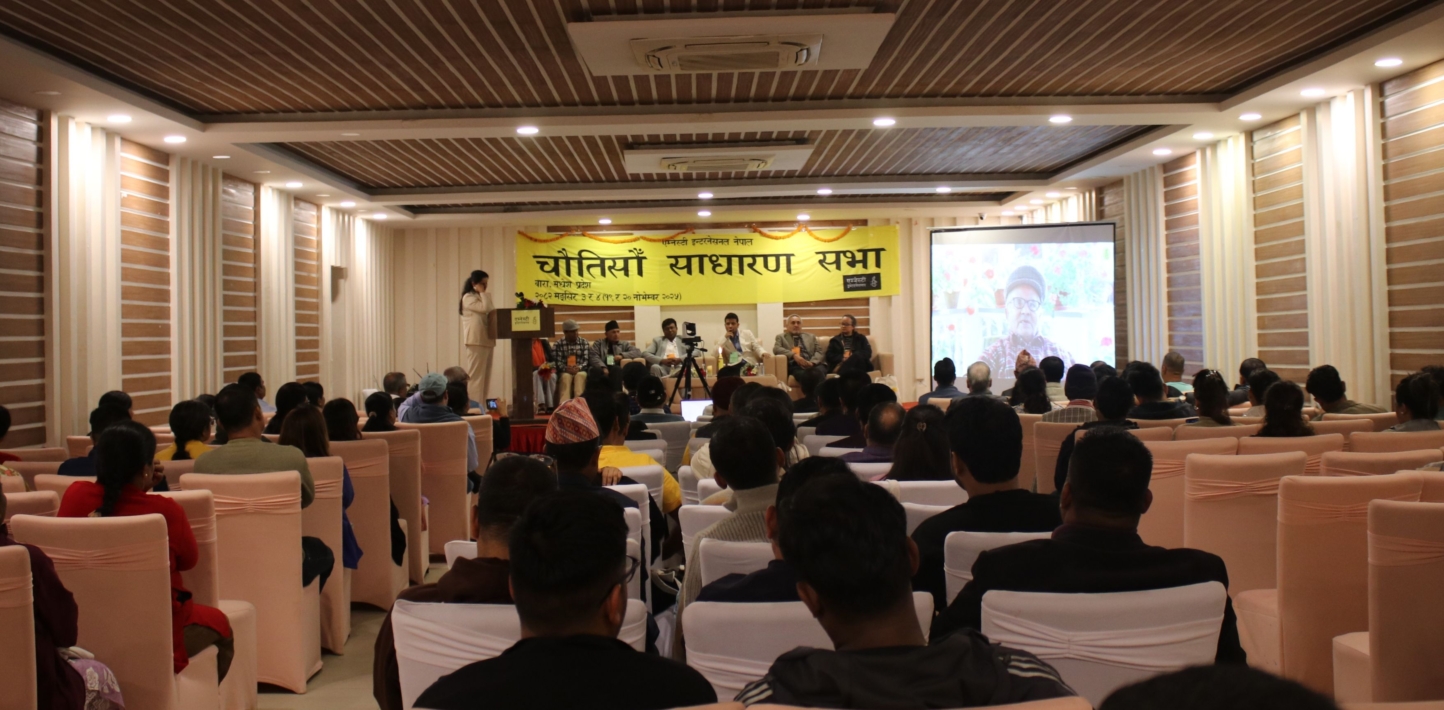
Amnesty International Nepal (Amnesty Nepal) successfully concluded its 34th Annual General Meeting (AGM) in Jeetpursimara, Bara, Madhesh Province, on 19–20 November 2025. The two-day event brought together around 150 participants, including 85 voting delegates representing Amnesty Nepal’s groups, Youth Networks, and individual members from across the country. Members of Amnesty Nepal’s Board and committees, former chairs, staff, volunteers, and observers were also present.
The AGM opened with a public action led by Amnesty Nepal members, calling for an end to the ongoing human rights crisis in Sudan. The action highlighted Amnesty International’s global campaign urging world leaders to address widespread atrocities and abuses in what has become the world’s largest humanitarian crisis. Despite the scale of these atrocities, international responses have largely remained muted, with minimal coordinated action to protect civilians or hold perpetrators accountable. Amnesty International has repeatedly called on the UN Security Council to take urgent measures, including halting the flow of arms, ensuring unhindered humanitarian access, and supporting independent investigations into war crimes and crimes against humanity.
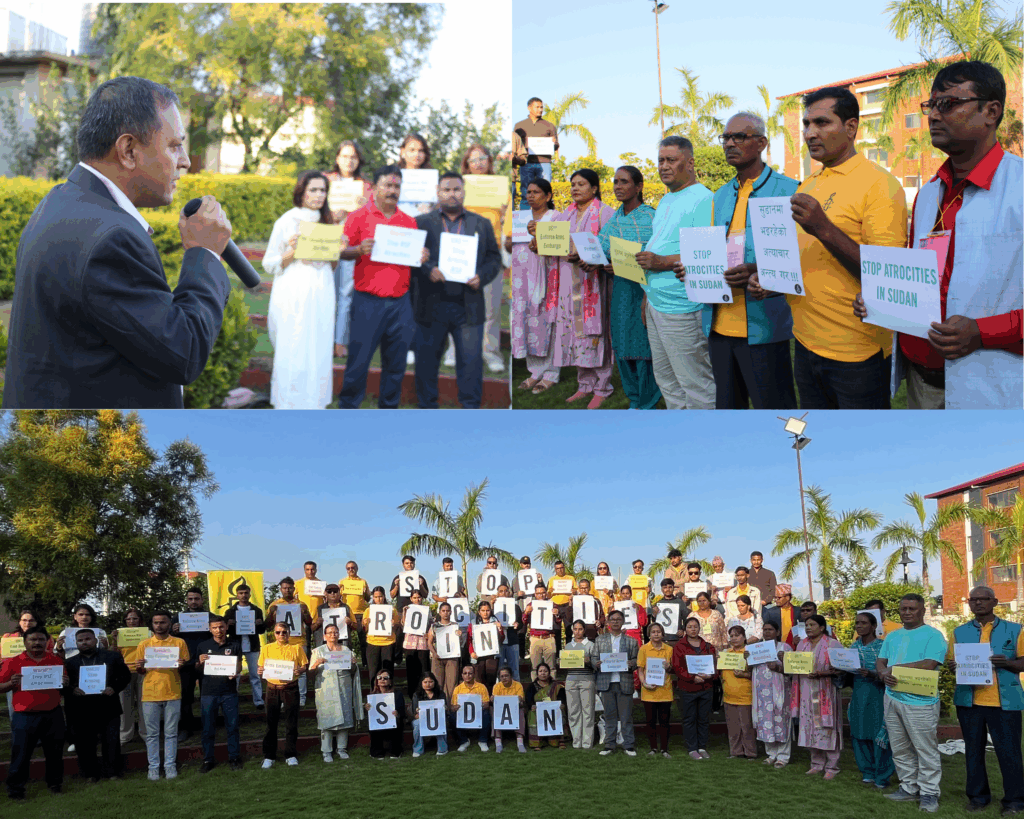
“The immense suffering in Sudan continues to meet an alarming silence from the international community,” said Nirajan Thapaliya, Director of Amnesty International Nepal. “Our action at the AGM echoes Amnesty’s global call for justice and accountability. The world cannot stay silent while civilians endure mass atrocities and starvation.”
The AGM was formally inaugurated by Buddha Narayan Sahani Kewat, Chief of the National Human Rights Commission Office in Madhesh. In his remarks, Kewat highlighted persistent human rights challenges in the province, including widespread poverty, a strained healthcare system, entrenched caste-based discrimination, child marriage, rising domestic violence, and the intensifying impacts of climate change. He emphasized that progress is impossible without state accountability and a functioning democracy:
“Caste-based discrimination, particularly against the Dalit community, remains deeply entrenched. Laws and mechanisms may exist, but when they fail to function and communities continue to suffer, real change remains out of reach,” he said.
Caste-based discrimination, particularly against the Dalit community, remains deeply entrenched. Laws and mechanisms may
Buddha Narayan Sahani Kewat, Chief of the National Human Rights Commission Office in Madhesh
exist, but when they fail to function and communities continue to suffer, real change remains out of reach
Speaking at the inaugural session, senior journalist and activist Purushottam Dahal expressed his regret towards how things appear to be sliding towards anarchy and lawlessness. He stressed that there is a need to respect and abide by the rule of law and the fundamentals of transparency and accountability by everybody, including the state functionaries. He also expressed his sadness at how organizations such as Amnesty who raise voice on such issues are vilified and targeted retributively, and yet, it is now more than ever before that the relevance of these organizations remains, he said.
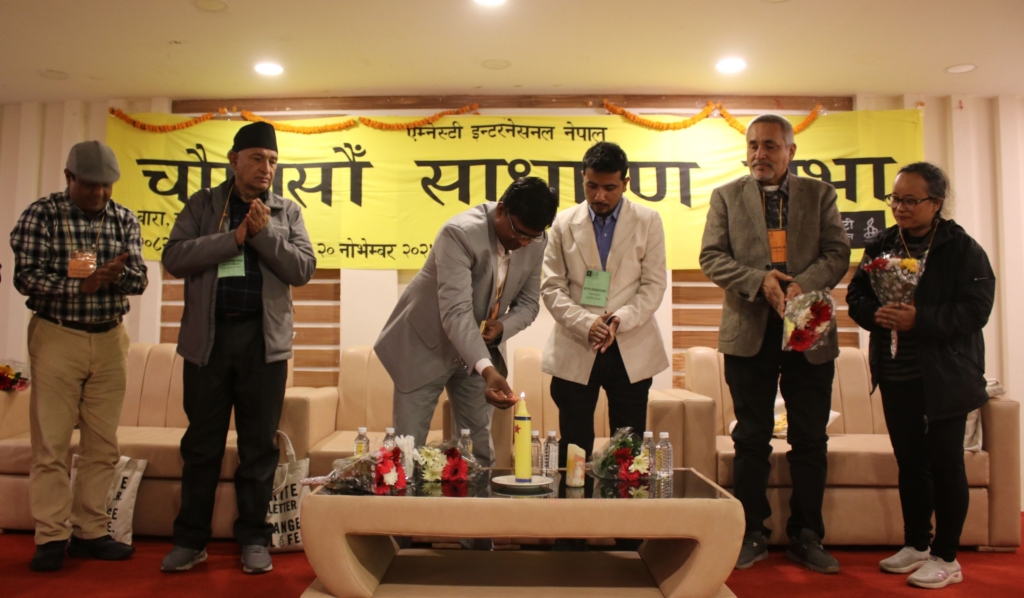
Senior Human rights activist and former Chair of Amnesty Nepal Charan Prasai also welcomed participants and reflected on Nepal’s current human rights landscape, particularly in the wake of the Gen Z protests, and highlighted the critical role of organizations like Amnesty Nepal in steering positive change by spreading human rights awareness, organizing sustained campaigns, mobilizing people power and spreading the message of collective solidarity, voice and action.
Another key highlight of the AGM was a panel discussion on “Intergenerational Dialogue: How can youths contribute to shaping a culture of rule of law, accountability, and human rights?” The panel, moderated by activist Praneta, featured political thinker and analyst Chandrakishore Jha, Indigenous Peoples’ Rights scholar and researcher Kailash Rai, founding General Secretary of the Conflict Victims’ Common Platform and activist Dr. Ram Kumar Bhandari, and lawyer Shailendra Ambedkar.
The panellists discussed Nepal’s deep-rooted structural discrimination, failures of governance, and the widening gap between constitutional promises and lived reality. While recent Gen-Z–led protests have demanded accountability and reform, the panellists noted that societal attitudes, institutional practices, and political systems have not transformed at the pace needed for true equality.
Chandrakishore Jha, reflecting on structural inequalities especially for the Madhes region, said, “Madhes has always been a land of struggle; people here have fought for dignity generation after generation. Yet our democracy remains confined to paper—unchanged in behaviour, in institutions, and in everyday expectations. The state alone cannot transform this; society must confront its own habits of political favouritism and social convenience.
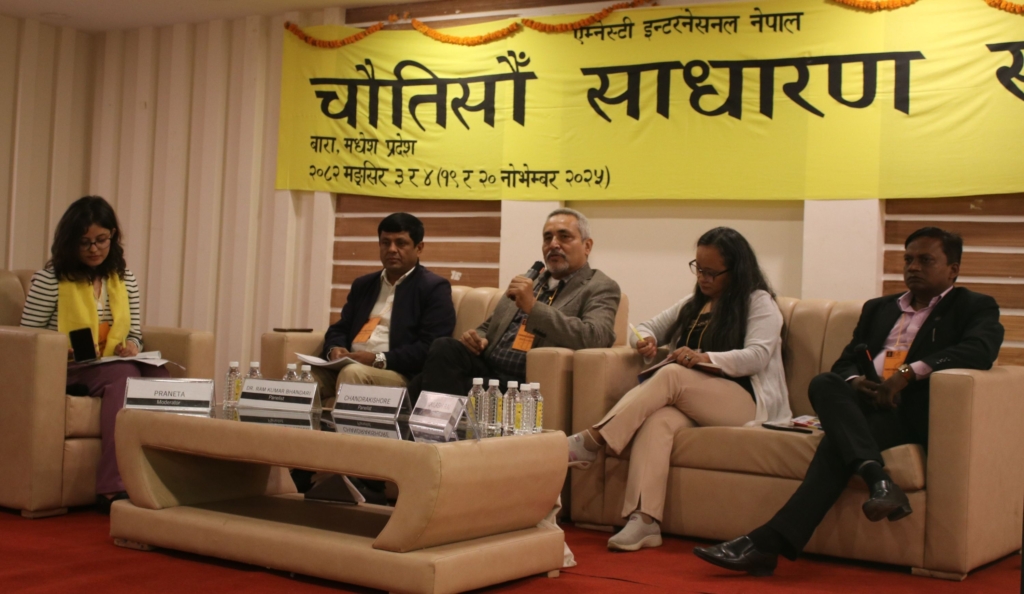
Reflecting on caste hierarchies and the systematically obstructed access to justice that Dalits face, Shailendra Ambedkar said, “Access to justice remains a distant dream for the Dalit community especially because Nepal’s caste system—rooted in Brahminism and Hindu hierarchy—still governs our institutions. From the police to civil society, discrimination is woven into everyday practice. Dalits are still denied full citizenship in their own country; rights written in the constitution mean little when the system protecting you is built on money, power, and exclusion.”
Kailash Rai, who spoke on government accountability, transparency, and institutional failure, said, “Our institutions fail because both the state and society avoid accountability. Transparency requires access to information, yet people are denied it at every step. Nepotism, patronage, and the politics of power, influence, and resources keep our systems opaque—and that is why we struggle to build a state that answers to its people.”
Drawing connections between past and present, Dr. Bhandari addressed the long-standing lack of accountability for conflict-era abuses, warning that the government’s tendency to avoid accountability and responsibility —as seen during the Maoist conflict—has contributed to a dangerous culture of impunity in Nepal. “The public has lost faith in Nepal’s political and structural institutions because the state has never confronted its own violence. For twenty years since the peace agreement, reports have been buried, crimes uninvestigated, and perpetrators rewarded with political positions. This systematic evasion of accountability has built a dangerous culture of impunity,” he said.
Following the panel discussion, the AGM moved towards the agenda that included the presentation, discussion, and approval of statutory reports for the fiscal year 2081/82, the organization’s annual human rights action plan and budget for 2026, and the appointment of auditors for the fiscal year 2082/83. Delegates also deliberated and approved amendments to the organization’s statute regarding regional meetings leading up to the AGM and elected Pratima Chapagain as a female member of the Preparatory Committee.
Wrapping up the AGM, AI Nepal Chairperson Bipin Budhathoki shared, “This AGM marks a crucial moment to reinforce our collective commitment to human rights. With the country undergoing significant political shifts, it is more important than ever that we remain focused on advancing human rights. The discussions and decisions we have made here will guide our work, helping us refine our strategic priorities for the year ahead and beyond, while strengthening the unity and engagement of Amnesty’s membership nationwide.”