

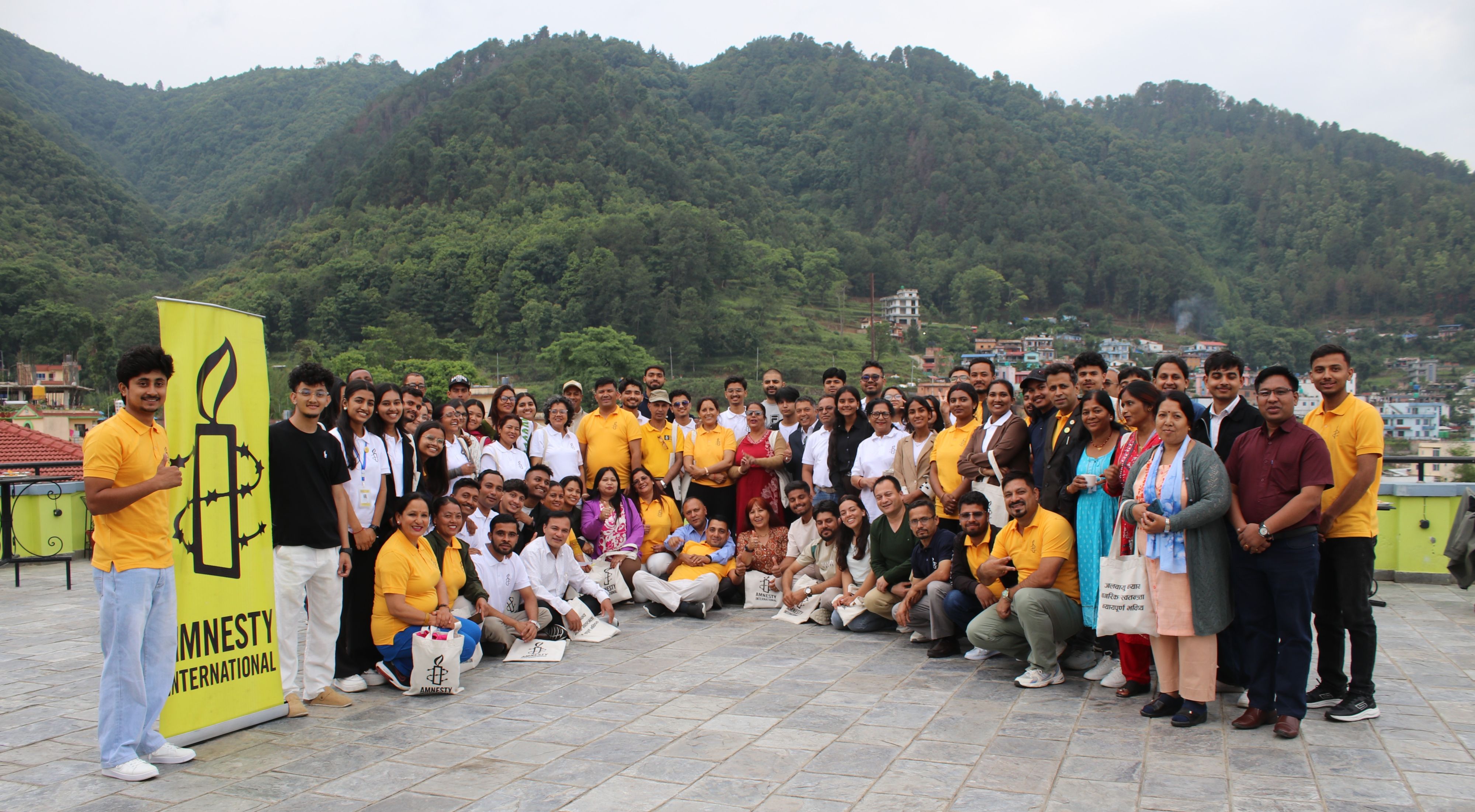
Amnesty International Nepal convened a two-day Human Rights Education (HRE) workshop bringing together over 80 Amnesty Nepal Youth Network and Group members from across the country from May 29-30. The workshop aimed to strengthen participants’ understanding of human rights principles while deepening their ability to connect rights-based frameworks to lived realities in Nepal, particularly in relation to right to access to land, sexual- and gender-based violence, individuals’ bodily autonomy, state accountability, historical injustices and structural inequality.
At the start of the workshop Amnesty International Nepal’s Chairperson Bipin Budhathoki encouraged participants to actively engage with human rights education not only as a learning process but as a practice within communities. He emphasized the importance of human rights education in addressing and responding to human rights violations in everyday life.
Nirajan Thapaliya, director of Amnesty Nepal, highlighted the persistence of misconceptions about human rights within patriarchal social structures, noting that these distortions are reflected in rising incidents of gender-based violence. He stressed that Human Rights Education plays a critical role in challenging harmful norms and enabling collective reflection on how societal attitudes can be transformed through awareness and dialogue.
The inaugural session also established collective ground rules and recognized the contributions of AI Nepal’s Youth Networks and Groups. The day concluded with a screening of “Panchayat ko ghau (Wounds of Panchayat)”, a documentary that highlighted how even state-led land reforms were manipulated by persons in power and privilege to systematically dispossess the marginalized farming communities of their land. Using an infotainment approach, the screening encouraged participants to reflect on human rights violations and broader social justice issues.
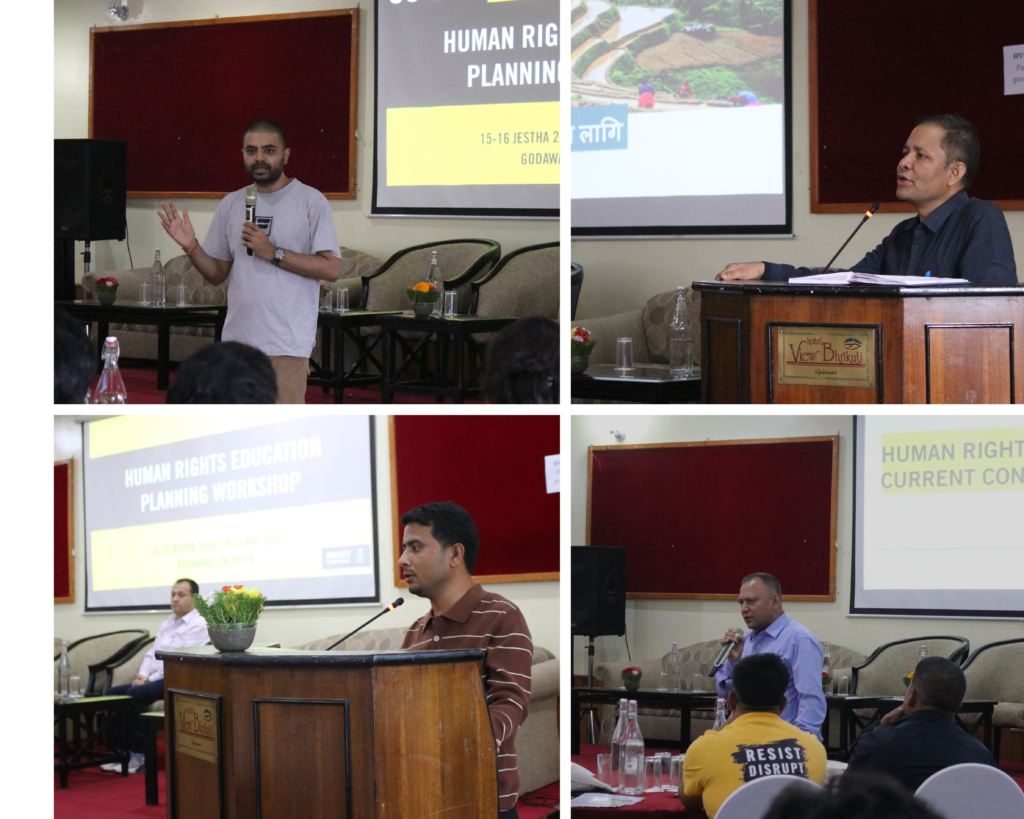
The second day focused on strengthening foundational human rights knowledge and applying it to real-world contexts through participatory learning. The first session, facilitated by Thapaliya, introduced the core concepts of human rights, including their universality, Amnesty International’s mandate and approach, distinctions between absolute and relative rights, and other key human rights principles. This was followed by an interactive workshop where participants engaged in peer discussions to critically examine state obligations to respect, protect, and fulfil human rights, encouraging reflection on how these principles are translated into practice within governance and broader society.
A key session led by Jagat Deuja, Executive Director of the Community Self Reliance Centre (CSRC), examined forced displacement, dispossession, and historical land inequality. The discussion situated land as a central human rights issue shaped by structural injustice, environmental stress, and governance gaps. It highlighted the shrinking availability of cultivable land due to rapid urbanization, desertification and climate change, concerns over undocumented or underutilized land despite agricultural potential, and the deep connection between land ownership, identity, and citizenship. The session also emphasized that ecological degradation is not only an environmental concern but also a direct human rights issue, as it impacts livelihoods, food security, and displacement patterns across vulnerable communities.
Subsequent discussions adopted a participatory approach, engaging participants in group work and dialogue on complex human rights issues including the death penalty, safe abortion, rights of SOGIESC minorities, torture, and forced eviction alongside the right to adequate housing. Through group presentations, quizzes, and mock training exercises, participants were encouraged to critically engage with both legal frameworks and societal attitudes shaping these issues.
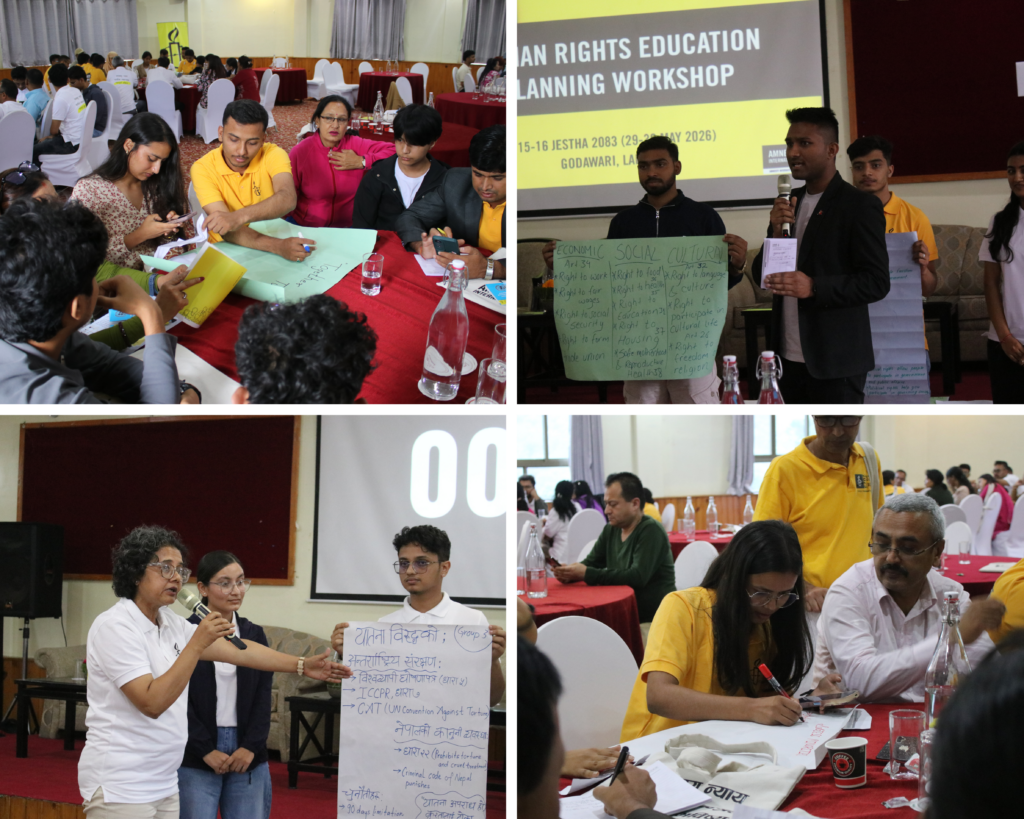
A dedicated session on Human Rights Education pedagogy by Human Rights Education Coordinator Kundan Raj Sharma further explored the practice of rights education itself. It also addressed practical aspects of facilitation such as structuring sessions, documentation, and reporting, reinforcing Human Rights Education as a continuous and transformative process rather than a one-time training intervention.
The workshop concluded with reflections on the interconnectedness of human rights, land governance, and social justice in Nepal. Across sessions, participants were encouraged to understand human rights not only as a legal framework but also as a lived experience shaped by inequality and social structures.